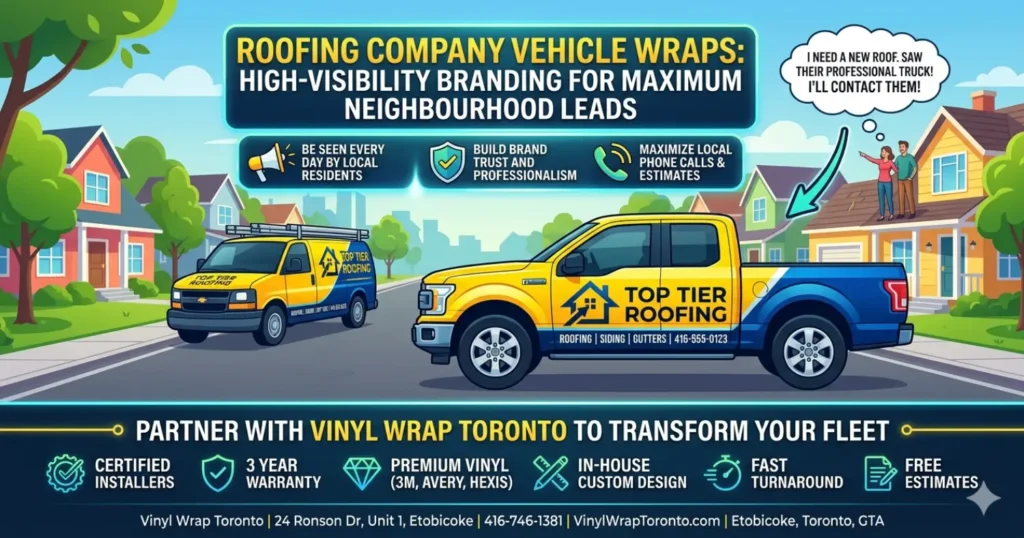
Every day your roofing trucks are on the road, parked in driveways, or sitting in front of a job site, they are either generating leads — or not. For roofing contractors across Toronto, Etobicoke, Brampton, Mississauga, Vaughan, and the wider GTA, roofing company vehicle wraps are the single highest-ROI marketing investment you are almost certainly underutilising.
Consider this: a professionally wrapped roofing truck parked in a residential neighbourhood while your crew completes a job doesn’t just advertise to the homeowner — it advertises to every neighbour who walks by, every driver who passes, and every person who glances out their window. In tightly clustered Ontario neighbourhoods where one roof job often triggers three to five inquiries from nearby homeowners, a high-visibility wrap is a hyper-local lead-generation engine that works around the clock.
This guide is written for roofing business owners, operations managers, and fleet decision-makers who want to understand how to maximise the branding impact of their vehicles — from design principles and wrap types to real-world costs, timelines, and common mistakes to avoid.
Why Vehicle Wraps Are a Roofing Contractor’s Most Powerful Local Marketing Tool
The Numbers Behind Mobile Advertising
Vehicle advertising consistently ranks among the most cost-effective forms of local marketing available to trade contractors. According to the Outdoor Advertising Association of America, a single wrapped vehicle can generate between 30,000 and 70,000 visual impressions per day in a dense urban or suburban environment. In markets like the GTA — with some of the highest traffic densities in Canada — that number can climb even higher.
What makes this particularly powerful for roofing companies is the neighbourhood clustering effect: when your truck is parked at a job site, it’s advertising directly to the households most likely to have the same roofing needs. A neighbour who sees your branded truck completing a job across the street already has social proof baked in — someone on their street trusted you enough to hire you.
| 📊 The Neighbourhood Lead Effect |
| Roofing is one of the most neighbourhood-driven trades in Canada. |
| When one homeowner on a street needs a roof, adjacent homes are often a similar age |
| and face the same wear conditions — meaning your parked, wrapped truck is directly |
| targeting your highest-probability next customers every single day you’re on site. |
| A wrap investment of $2,500–$5,000 can generate leads for 5–7 years. |
Vehicle Wraps vs. Other Marketing Channels for Roofers
| Marketing Channel | Avg. Monthly Cost (CAD) | Local Targeting | Passive Lead Gen? | Lifespan |
| Vehicle wrap (amortised) | $50–$100/mo | ✔ Hyper-local | ✔ Yes — 24/7 | 5–7 years |
| Google Ads (local roofing) | $800–$3,000+/mo | ✔ Geo-targeted | ✘ Paid only | Active spend only |
| Lawn signs (at job sites) | $200–$500/batch | ✔ Hyper-local | Partial | Weeks to months |
| Door hangers (per campaign) | $300–$800 | ✔ Targeted routes | ✘ One-time | Single campaign |
| Social media ads | $500–$2,000/mo | Moderate | ✘ Paid only | Active spend only |
| Local newspaper / flyer | $400–$1,500 | Moderate | ✘ One-time | Single campaign |
| Branded yard signage | $150–$400/sign | ✔ Hyper-local | Partial | Months |
Vehicle wraps deliver the lowest cost-per-impression of any marketing channel available to roofing contractors in the GTA — and they’re the only channel that works passively while your team is actively doing the job.
Roofing Company Vehicle Wrap Options: Choosing the Right Coverage
Not every roofing company vehicle wrap needs to be a full wrap. The right option depends on your fleet size, budget, branding goals, and the type of vehicles you operate. Here’s a breakdown of your main options:
Full Vehicle Wrap
A full wrap covers the entire vehicle — all panels, doors, bonnet, roof, and rear — in branded vinyl. For roofing companies, this is the highest-impact option and the most effective at turning a plain white or grey truck into a rolling billboard.
- Best for: Owner-operators, lead vehicles, trucks that operate in high-visibility residential areas
- Visual impact: Maximum — 360° branding from every angle
- Typical cost (GTA): $2,500–$5,000 per full-size pickup truck or cargo van
Partial Wrap
A partial wrap covers a defined section of the vehicle — typically the rear panels, cab doors, tailgate, and rear windows. This is an excellent balance between cost and impact, and works particularly well on pickup trucks where the rear and side doors are the most visible surfaces at a job site.
- Best for: Budget-conscious operators, mixed fleets with varying vehicle types
- Visual impact: High — especially effective when vehicles are parked at job sites
- Typical cost (GTA): $1,200–$2,800 per pickup truck or cargo van
Decals & Lettering
Vehicle lettering uses cut or printed vinyl to apply your company name, phone number, tagline, and logo to key panels. While less visually dramatic than a full or partial wrap, professional lettering is a clean, credible, and cost-effective way to brand a large fleet quickly.
- Best for: Large fleets, budget constraints, vehicles that frequently change livery
- Visual impact: Moderate — professional but limited design complexity
- Typical cost (GTA): $300–$900 per vehicle depending on complexity
| 💡 Roofing Fleet Strategy Tip |
| If you’re branding a fleet of 5+ trucks, consider a tiered approach: |
| • Lead / owner vehicle: Full wrap for maximum impact |
| • Crew trucks and vans: Partial wrap or high-quality lettering |
| This strategy maximises neighbourhood visibility while keeping per-vehicle |
| costs manageable across a larger fleet. |
High-Visibility Wrap Design: What Actually Works for Roofing Companies
The design of your contractor truck wrap can make the difference between a passing glance and a homeowner pulling out their phone to take a photo of your number. Here are the design principles that consistently produce results for trades businesses in Toronto and across Ontario:
1. Legibility at Distance and in Motion
Most of your wrap’s impressions happen at 50–80 km/h or from across a street. Design for the worst viewing condition, not the best. This means:
- Minimum 4–6 inch tall lettering for primary text
- High-contrast colour combinations — dark backgrounds with white or yellow text consistently outperform light-on-light schemes
- Sans-serif fonts for readability (avoid script or decorative typefaces for contact info)
- Phone number displayed at the largest possible size — it’s your single most important piece of information
2. Lead with Your Core Service and Location
Homeowners in Etobicoke, Vaughan, or Mississauga don’t need to know everything you do — they need to know you do roofing and that you serve their area. Your wrap should communicate: who you are, what you do, where you serve, and how to reach you — in that order of visual hierarchy.
- Company name: Largest element after any graphic/logo
- Primary service: “Roofing” or “Roof Replacement & Repair” in clear, prominent text
- Service area: “Serving Toronto, GTA & Surrounding Areas” builds trust and relevance
- Phone number: Displayed prominently on the rear and both sides — where parked vehicles are most visible
- Website / QR code: Secondary element — useful but never at the expense of phone number clarity
3. Use a Consistent, Recognizable Brand Colour Palette
Consistency across all your trucks is what builds brand recognition in a neighbourhood over time. When residents in Etobicoke or North York repeatedly see the same bold red-and-black trucks on their streets, your brand becomes embedded in their mental shortlist long before they need a roofer.
- Limit your palette to 2–3 colours maximum
- Ensure your wrap colours align with your logo, website, and uniform colours
- Choose colours that contrast strongly with your base vehicle colour (typically white)
4. Incorporate Roofing-Specific Visual Elements Strategically
Strong roofing wraps often incorporate imagery or graphic elements that immediately communicate the trade — roof lines, shingle patterns, a stylised house silhouette, or a bold skyline graphic. These visuals should complement your branding without competing with your contact information.
Avoid cluttered designs with excessive imagery, multiple fonts, lengthy service lists, or decorative elements that reduce legibility. The wrap is not a brochure — it’s a billboard.
| Design Element | Best Practice | Common Mistake to Avoid |
| Company name | Large, top or side panel, high contrast | Too small, buried in design |
| Phone number | Largest text element — minimum 5–6 inches tall | Small, same size as other text |
| Service description | Short & clear: ‘Roofing & Eavestrough’ | Long lists of every service offered |
| Service area | One concise line: ‘Serving the GTA’ | Listing every city in small text |
| Imagery / graphics | One strong focal graphic, supporting role only | Multiple competing images or stock photos |
| Colours | 2–3 colours, high contrast, brand-consistent | Too many colours, low contrast combos |
| Logo | Prominent but not dominant | Logo as the only identifier with no text |
| Website / QR code | Included but secondary to phone number | Prioritised over phone number or address |
Fleet Branding for Roofing Companies: Scaling Your Presence Across the GTA
Why Fleet Consistency Is Your Biggest Branding Multiplier
A single wrapped truck is a lead-generation asset. A fleet of consistently branded trucks is a market dominance strategy. When homeowners in a neighbourhood see your trucks repeatedly — parked at different properties, on different streets, over the course of a season — you stop being “a roofing company” and start being the roofing company they think of when their roof comes up at the next street barbecue.
For roofing businesses operating in competitive markets like Toronto, Mississauga, or Brampton, fleet consistency also signals scale, professionalism, and stability — all of which are trust signals that influence a homeowner’s decision to call you versus an unbranded competitor.
Fleet Wrap Pricing: What to Budget Per Vehicle (GTA Rates)
| Vehicle Type | Wrap Option | Material Cost (CAD) | Labour (CAD) | Total Est. (CAD) | Lifespan |
| Full-size pickup (e.g. F-150, RAM 1500) | Full wrap | $900–$1,400 | $1,200–$1,800 | $2,100–$3,200 | 5–7 yrs |
| Full-size pickup | Partial wrap | $500–$800 | $700–$1,100 | $1,200–$1,900 | 5–7 yrs |
| Full-size pickup | Lettering | $150–$300 | $200–$400 | $350–$700 | 5–7 yrs |
| Cargo van (full size) | Full wrap | $1,200–$1,800 | $1,400–$2,200 | $2,600–$4,000 | 5–7 yrs |
| Cargo van | Partial wrap | $600–$1,000 | $800–$1,300 | $1,400–$2,300 | 5–7 yrs |
| Box truck / flat deck | Full wrap | $1,500–$2,500 | $1,800–$3,000 | $3,300–$5,500 | 5–7 yrs |
| Trailer (branded panels) | Partial wrap | $700–$1,200 | $600–$1,000 | $1,300–$2,200 | 5–7 yrs |
Prices reflect the Toronto, Etobicoke, Mississauga, Brampton, and Vaughan market as of 2024–2025 using premium vinyl (3M, Avery Dennison, or KPMF). Volume discounts of 10–20% are common for fleet orders of 3 or more vehicles.
| 🚛 Fleet Volume Discount |
| Most GTA wrap shops offer volume pricing for fleets of 3 or more vehicles. |
| Ordering 5+ trucks or vans at once can reduce the per-vehicle cost by 10–20% |
| and ensures colour and design consistency across the entire fleet. |
| Ask your wrap provider about fleet pricing and phased rollout options. |
Calculating the ROI of Roofing Vehicle Wraps
Let’s make this concrete. A full wrap on a roofing truck in the GTA costs approximately $2,500–$4,000. Over a 5-year lifespan, that’s roughly $500–$800 per year, or $40–$65 per month. Compare that to the average value of a single roofing job in Ontario — which can range from $8,000 to $25,000+ for a full replacement — and the math becomes straightforward: your wrap pays for itself with a single lead converted to a signed contract.
| Metric | Estimate |
| Full wrap cost (pickup truck, GTA) | $2,500–$4,000 |
| Wrap lifespan | 5–7 years |
| Amortised monthly cost | $40–$65/month |
| Daily impressions (urban/suburban GTA route) | 30,000–70,000+ |
| Average roofing job value (Ontario) | $8,000–$25,000+ |
| Jobs needed to recover wrap cost | 1 job (full replacement) |
| Estimated cost per 1,000 impressions | $0.10–$0.25 |
No other marketing channel available to a Toronto or GTA roofing company delivers this combination of cost-per-impression, longevity, and hyper-local targeting. Digital advertising requires ongoing monthly spend that stops generating leads the moment you pause the budget. A wrapped truck keeps working whether you’re on the job site, parked overnight in a neighbourhood, or driving to your next estimate.
The Roofing Vehicle Wrap Process: From Quote to Road-Ready
Understanding the process helps you plan your wrap project without surprises. Here’s a typical timeline for a roofing company wrap project with a professional GTA-area provider:
| Stage | What Happens | Typical Timeframe |
| 1. Consultation & Quote | Discuss vehicle types, wrap options, design goals, and budget. Receive a written quote. | 1–3 business days |
| 2. Design | In-house design team creates wrap concept(s) using your branding. Revisions included. | 3–7 business days |
| 3. Design Approval | You review and approve the final design before production begins. | 1–2 business days |
| 4. Print & Production | Wrap graphics are printed on premium vinyl and laminated. | 2–4 business days |
| 5. Installation | Certified installers apply the wrap in a controlled, climate-regulated environment. | 1–2 days per vehicle |
| 6. Quality Inspection | Wrap is inspected for bubbles, lifting edges, and alignment before vehicle is returned. | Same day as install |
| 7. Post-Install Care | Care instructions provided. Avoid washing for 48–72 hours after install. | Day of pickup |
Total project timeline: Most roofing company wrap projects — from first contact to vehicle pickup — are completed within 2–3 weeks for standard orders. Fleet projects or designs requiring multiple revision rounds may take 3–4 weeks. Plan accordingly around your busy season — spring and fall are peak periods for both roofing work and wrap shops in Ontario.
Common Mistakes Roofing Companies Make with Vehicle Wraps
- Prioritising aesthetics over legibility. A beautifully designed wrap that can’t be read from 10 metres away is a missed opportunity. Every design decision should serve readability first, aesthetics second.
- Omitting the phone number from the rear of the vehicle. The rear of a truck or van is one of its highest-impression surfaces — it’s what drivers behind you see for minutes at a time in traffic. A large, clear phone number on the tailgate or rear doors is non-negotiable.
- Using inconsistent branding across the fleet. Different fonts, colours, or layouts across your trucks fragments your brand identity. The goal is for every vehicle in your fleet to be immediately recognisable as yours — even in a rear-view mirror at distance.
- Choosing the cheapest material available. Budget vinyl films degrade quickly in Ontario‘s UV, road salt, and temperature extremes. A wrap that fades, peels, or bubbles after 18 months doesn’t just look unprofessional — it actively damages your brand. Invest in premium vinyl from 3M, Avery Dennison, or KPMF.
- Not including a clear service area statement. “Serving Toronto & the GTA” or “Etobicoke, Brampton, Mississauga & Beyond” tells potential customers immediately that you work in their neighbourhood. Without it, homeowners may assume you don’t service their area and move on.
- Skipping the design brief. Showing up to a wrap shop without clear brand guidelines, an approved logo file, and defined colour values leads to revisions, delays, and sometimes a final product that doesn’t align with your other marketing. Prepare a simple brand brief before your first meeting.
- Neglecting post-wrap maintenance. Even the best wrap won’t hold up if your trucks are being run through automated brush car washes, left covered in road salt for weeks, or parked outdoors without any care. Follow your installer’s care guidelines to maximise lifespan.
Maintaining Your Roofing Vehicle Wrap: Protecting Your Investment
A professionally installed wrap using premium vinyl can last 5–7 years — but only with basic care. For roofing trucks that face demanding conditions (dust, debris, tarps, ladders, and year-round outdoor exposure in Ontario), the following practices will maximise your wrap’s lifespan:
- Hand wash only (or touchless wash). Automated brush car washes can lift edges and create micro-tears in the vinyl. Use a gentle hand wash or a touchless automatic wash.
- Use pH-neutral soap. Harsh detergents and degreasers degrade the vinyl finish and adhesive over time.
- Rinse road salt off promptly in winter. Ontario road salt is corrosive to both the wrap and the vehicle underneath. Rinse your trucks after heavy salt exposure.
- Address lifting edges immediately. If an edge begins to lift — common near panel corners or door edges — have it re-sealed promptly. Left unaddressed, edge lifting propagates quickly.
- Avoid prolonged direct UV exposure where possible. If trucks are garaged or parked under cover when not in use, the wrap will last significantly longer than one left outdoors year-round.
- Do not apply wax or polish to matte or satin finishes. Wax will alter the sheen of matte finishes. Use wrap-specific detailing products for non-gloss finishes.
Conclusion: Your Roofing Trucks Are Your Best Salespeople — Brand Them Like It
Every roofing contractor in Toronto, Etobicoke, Mississauga, Brampton, and Vaughan is competing for the same pool of homeowners. The contractors who build the strongest neighbourhood presence — whose names and numbers residents know before they even need a roofer — win the lion’s share of local business. Roofing company vehicle wraps are the most efficient, most cost-effective tool available to build that presence. A high-visibility, professionally designed wrap on your pickup trucks and vans transforms every kilometre driven and every hour parked at a job site into a paid marketing impression — at a cost-per-lead that no digital channel can match. Done right, with premium materials, certified installation, and a design built for legibility, a contractor truck wrap will generate leads, build recognition, and reinforce your credibility in Ontario neighbourhoods for years to come.
📞 Ready to turn your roofing fleet into your most powerful lead-generation asset? Contact Vinyl Wrap Toronto today for a free consultation and quote. Serving roofing companies and trades businesses across Etobicoke, Toronto, Mississauga, Brampton, Vaughan, and all of the GTA.
FAQ: Vehicle Wraps for Roofing Companies
-
How much does a vehicle wrap cost for a roofing company in Toronto?
For GTA-area roofing companies, a full wrap on a full-size pickup truck typically costs $2,100–$3,200 including materials and professional installation. Partial wraps range from $1,200–$1,900, and lettering/decal packages start from $350–$700 per vehicle. Cargo vans and box trucks cost more due to larger surface area. Volume discounts of 10–20% are generally available for fleets of 3 or more vehicles.
-
How long will a roofing truck wrap last in Ontario’s climate?
A professionally installed wrap using premium vinyl (3M, Avery Dennison, or KPMF) will typically last 5–7 years with proper care. Key factors affecting lifespan in Ontario include UV exposure, road salt exposure in winter, washing method, and whether trucks are garaged or parked outdoors. Promptly addressing any lifted edges will significantly extend the wrap’s life.
-
What information should I include on my roofing company vehicle wrap?
At minimum, your roofing company vehicle wrap should include: your company name (largest element), your primary service (e.g., “Roof Replacement & Repair”), your phone number (as large as possible, especially on the rear), your service area (e.g., “Serving Toronto & the GTA”), and your website or logo. Avoid overloading the design with every service you offer — clarity and legibility at distance are the priorities.
-
Is a full wrap worth it, or is lettering sufficient for a roofing truck?
Both serve a purpose, but they deliver different results. Lettering is cost-effective and professional, particularly for large fleets or tight budgets. Full wraps deliver significantly more visual impact, better brand recall, and a stronger impression of professionalism and scale. For owner-operators and lead vehicles in high-visibility markets like Toronto and Mississauga, a full or partial wrap almost always delivers a stronger return on investment than lettering alone.
-
Can I wrap a leased roofing truck or company vehicle?
Yes. Vinyl wraps are a preferred branding solution for leased vehicles precisely because they are fully removable without damaging the vehicle’s factory paint. When the lease ends, the wrap can be professionally removed, leaving the vehicle in original condition. This is standard practice for GTA roofing companies operating mixed owned-and-leased fleets. Always confirm with your installer that they use removable-grade vinyl for leased assets.
-
How long does it take to wrap a roofing truck or fleet?
A single full-size pickup truck or cargo van can typically be wrapped within 1–2 days once the design is approved and materials are printed. A complete fleet wrap project — from initial consultation to final vehicle pickup — typically takes 2–3 weeks for standard orders. Planning your wrap project before the spring roofing season (ideally January–February) ensures you’re road-ready when the busy season begins in Ontario.
-
Should I use the same wrap design on all my roofing trucks?
Yes — consistency is one of the most important strategic advantages of fleet branding. When every truck in your fleet carries the same colours, logo, and contact information, your brand becomes recognizable and memorable in the neighbourhoods you serve. Homeowners in Brampton, Vaughan, or Etobicoke who see your trucks repeatedly across multiple properties on their street will recall your brand far more readily than those exposed to inconsistent or one-off signage.